Pharmaceutical grade methylene blue capsules are capsules filled with methylene blue made to the United States Pharmacopeia (USP) standard, the grade meant for something you swallow. The same molecule is also sold as a lab stain, a textile dye and a fish-tank treatment, and those grades are not made for people. Nobody hands out a “pharmaceutical grade” badge. Any seller can print the phrase, so it only means something when two things back it up: USP grade on the label and a lab report you can read that says what was tested.
This guide covers what the grade does and doesn’t tell you, how the capsules on sale in September 2026 compare, what their published lab documents actually show, and why most doctors don’t prescribe methylene blue for focus. NooBlue makes methylene blue capsules, so we are one of the brands in the comparison. Every figure for the other brands comes from their own product pages and lab documents.
Key Takeaways
- “Pharmaceutical grade” is a description, not a certificate. USP grade on the label plus a readable lab report is what backs it up.
- Lab documents come in three kinds: a raw-ingredient report, a finished-capsule lot report and a manufacturer’s specification sheet. Each proves something different.
- Capsules on sale now hold 5 mg to 20 mg of methylene blue each. You can’t split a capsule accurately, so the strength you buy is the dose you take.
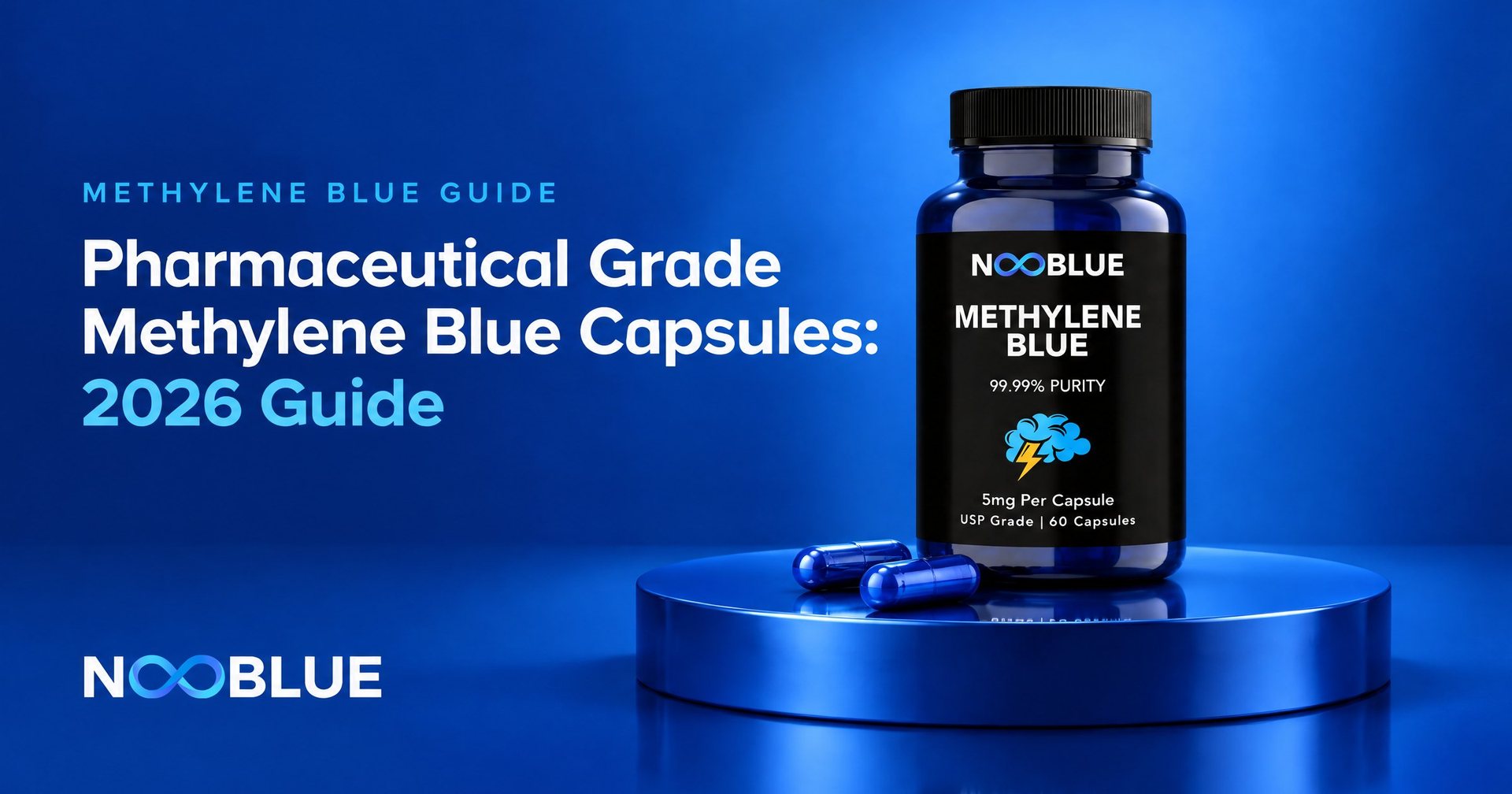
- NooBlue Ultimate Methylene Blue Capsules hold 5 mg of USP grade methylene blue and 10 mg of vitamin C, 60 per bottle, one a day with food.
- Do not take methylene blue with serotonergic medicines, with G6PD deficiency, in pregnancy or breastfeeding, or under 18.
Table of contents
- 1. What “Pharmaceutical Grade” Means on a Methylene Blue Capsule
- 2. Pharmaceutical Grade Methylene Blue Capsules Compared (as of Sep 2026)
- 3. What Their Lab Documents Actually Show
- 4. How to Check Pharmaceutical Grade Methylene Blue Capsules in 5 Steps
- 5. Strength: Why a 5 mg Capsule
- 6. Prescription and Compounded Methylene Blue Capsules
- 7. Safety: Read This Before Taking Methylene Blue Capsules
- 8. Frequently Asked Questions About Pharmaceutical Grade Methylene Blue Capsules
- 8.1. Which methylene blue supplement is the best?
- 8.2. What brand of methylene blue is legit?
- 8.3. Is pharmaceutical grade the same as USP grade?
- 8.4. Do pharmaceutical grade methylene blue capsules need a certificate of analysis?
- 8.5. What happens if I take methylene blue every day?
- 8.6. Why don’t doctors prescribe methylene blue?
- 8.7. How much do pharmaceutical grade methylene blue capsules cost?
- 8.8. Are capsules better than liquid methylene blue?
- 9. Sources
What “Pharmaceutical Grade” Means on a Methylene Blue Capsule
Methylene blue started life as a textile dye, and the molecule, methylthioninium chloride, is still made in bulk for dyeing, microscope staining and aquarium use. Those buyers don’t need the powder to meet limits for anything a person would swallow. That history is why the grade matters more here than it does for most supplements. Our explainer on what methylene blue is made from walks through how it is produced.
You will see four kinds of methylene blue for sale:
- USP grade. Made and tested to the USP monograph for methylene blue, which sets identity, assay and impurity tests. This is the grade to look for in a capsule. When a supplement label says “pharmaceutical grade”, it usually means the seller says the powder meets this standard. Our USP grade methylene blue comparison goes deeper.
- Lab, reagent or technical grade. Made for staining and analysis, where purity is judged by how well the dye works on a slide. See lab grade vs pharmaceutical grade methylene blue for the full breakdown.
- Aquarium products. A different product altogether. Kordon’s 2.303% fish-tank solution states on its product page that it is “not intended for human consumption”. We explain why aquarium methylene blue is not a supplement.
- “Food grade” labels. These raise their own questions, which we cover in our guide to food grade methylene blue.
A capsule adds two questions the powder grade can’t answer. How much methylene blue ended up in each capsule? And what else went in with it? Those are finished-product questions, and a USP grade raw material doesn’t settle them on its own.
Then there is the “99% pure” line that most bottles print. On its own it doesn’t say who measured it, on which lot, or what the other 1% is. Our guides to what methylene blue purity figures mean and the purest methylene blue brands and their documents go through how to read those claims.
Pharmaceutical Grade Methylene Blue Capsules Compared (as of Sep 2026)
These are the capsules that come up when you search for pharmaceutical grade methylene blue capsules, plus our own. NooBlue makes the Ultimate Methylene Blue Capsules. They are our pick, and every figure for the other capsules is taken from their own product pages and lab documents. We did not lab-test any competitor. Prices are brand-store prices as of Sep 2026.
| Capsule | Methylene blue per capsule | Capsules per bottle | Price (as of Sep 2026) | Other ingredients | Lab document you can read |
|---|---|---|---|---|---|
| NooBlue Ultimate Methylene Blue Capsules (our pick) | 5 mg, USP grade | 60 | $37.99 | 10 mg vitamin C, rice flour, cellulose capsule | CTLA report on the methylene blue ingredient lot: identity plus four heavy metals |
| Chemist Labs Methylene Blue Capsules | 10 mg | 60 or 120 | $34.99 (60), $44.99 (120) | Store description lists a vegan capsule | Lab reports linked for three capsule lots |
| Nutricel Blue Boost 60 | 12 mg | 60 | $34.90 | Vitamin C ester, organic cacao | Eurofins report listed for potency, heavy metals and microbes |
| Earth Harmony Ultimate Methylene Blue | 12 mg | 60 | $39.95 | Vitamin C, organic berberine, chlorophyllin, chlorophyll | Third-party testing stated; no report on the product page |
| Optimal Human USP Grade Methylene Blue 10mg Capsules | 10 mg | 60 | $39.99 | Rice flour, gellan gum, delayed-release vegetable capsule | Manufacturer’s specification sheet for lot 60078 |
| aSquared Nutrition Methylene Blue Capsules | 6 mg (12 mg per 2-capsule serving) | Not stated | $34.99 | 300 mg cacao per serving, alpha lipoic acid, vitamin C ester, MCT oil powder | Testing in an ISO 17025 lab stated; no report linked |
| Raden Wellness Methylene Blue Capsules | 20 mg | 60 | $119.99 | Not stated on the page | None linked; a provider consultation and lab work come first |
Why NooBlue is our pick. It is the smallest fixed dose in the table at 5 mg a capsule, and the label serving is one capsule a day. The formula is short: methylene blue, 10 mg of vitamin C, rice flour and a cellulose capsule. The product page shows the lab report next to a plain statement of what it covers. A bottle is $37.99, about $0.63 a capsule, with 30-day returns and free worldwide shipping on orders over $100.
Where others do better. The 10 mg and 12 mg capsules cost less per milligram, and the 120-count Chemist Labs bottle has the lowest price per milligram of the bottles here that state a count. Chemist Labs and Nutricel publish reports tied to finished-capsule lots, while our report covers the methylene blue ingredient lot. If you want a higher single dose, those brands sell one. We think 5 mg is the better place to start, and the next section explains why the strength matters.
For brand-by-brand reviews, see our comparison of the best methylene blue capsules. If you are open to other formats, the best methylene blue supplements roundup covers drops and gummies too, and our guide on how to choose a methylene blue supplement sets out the checks in order.
What Their Lab Documents Actually Show
“Third-party tested” can mean very different things. We opened the documents these brands link and sorted them into three kinds.
| Document | Example | What it shows | What it doesn’t show |
|---|---|---|---|
| Raw-ingredient report | NooBlue: Contract Testing Laboratories of America (CTLA) report 135621, ingredient lot 2025022801 | Identity by HPLC: “Conforms”. Arsenic <0.001 ppm, cadmium 0.010 ppm, mercury <0.001 ppm, lead <0.001 ppm | No purity percentage. It covers the methylene blue ingredient, not each finished bottle |
| Finished-capsule lot report | Chemist Labs: CTLA reports for capsule lots 2512701 and 2602801 (two of the three lots it links) | Lot 2512701: identity by FTIR 97.9%, methylene blue 3.638% of the sample by HPLC, microbial counts and four heavy metals. Lot 2602801: microbial counts and four heavy metals | The 3.638% is a share of the capsule contents, and the report gives no fill weight to turn it into milligrams. The newer lot’s report has no methylene blue result |
| Manufacturer’s specification sheet | Optimal Human: “Finished Product Specification”, lot 60078 | A target of 10 mg per capsule and results marked “Conforms/Pass” | It is on the manufacturer’s letterhead with no outside lab named, and the microbial and heavy-metal lines are marked “Typical results” |
Nutricel’s certificates page lists a Blue Boost report covering “Methylene blue potency, heavy metals & microbial safety”, tested July 2025, by Eurofins. That is the kind of finished-product potency check most brands in this list don’t publish.
Every one of these documents describes a sample. The CTLA reports we read carry the lab’s standard line that the certificate “represents data for the sample submitted and does not constitute a guarantee of quality for the entire product from which it was taken.” That applies to our report as much as anyone’s. A lab report is evidence about one lot, not a promise about every bottle.
We publish our CTLA report on every product page and on our quality and testing page, with the scope written beside it. Our step-by-step guide to reading a methylene blue certificate of analysis shows what to check on any brand’s document.
How to Check Pharmaceutical Grade Methylene Blue Capsules in 5 Steps
- Read the grade and the milligrams per capsule. Look for USP grade. Then find the mg per capsule, not per serving. aSquared, for example, lists 12 mg per 2-capsule serving, which is 6 mg in each capsule.
- Check what the product is for. Aquarium and lab products say so on the label or product page. If a methylene blue product says it is not for human consumption, believe it.
- Open the lab document and find its scope. Is it a raw-ingredient report, a finished-capsule lot report or a specification sheet? Each answers a different question, as the table above shows.
- Check the lab, the lot and the method. A real report names the lab, gives a lot number and lists a method and a unit next to each result. A finished-product report should match the lot on your bottle.
- Read the warnings. A capsule sold for daily use should warn about serotonergic medicines, G6PD deficiency and pregnancy. Ours names all three, plus breastfeeding and under-18s.
Where you buy matters as well. We looked at whether health food stores and pharmacies stock methylene blue, and our breakdown of what methylene blue costs gives price benchmarks to judge a listing against.
Strength: Why a 5 mg Capsule
The capsules in this guide hold anywhere from 5 mg to 20 mg of methylene blue. You can’t split a capsule accurately, so the strength on the label is the dose you take every day. It is worth choosing on purpose.
The best-known human study behind the interest in methylene blue used far more than any supplement capsule. In a randomized, placebo-controlled imaging trial published in Radiology, 26 adults were enrolled, and the 13 in the methylene blue group took a single 280 mg dose of USP grade methylene blue in capsules. An hour later, their brains showed more activity during attention and short-term memory tasks, and they gave 7% more correct answers on memory retrieval (Rodriguez et al., 2016). That was one dose, measured once. It doesn’t tell you what a daily 5 mg or 12 mg capsule does, and no capsule in this list reproduces it.
The wider interest comes from methylene blue’s redox chemistry. A review in Molecular Neurobiology describes how it can pass electrons along the mitochondrial electron transport chain and increase the activity of complex IV, mostly from cell and animal research (Tucker, Lu and Zhang, 2018).
Given how thin the human evidence on daily use is, we think a low, exact dose makes sense. The NooBlue label serving is one 5 mg capsule a day with food, and the label says not to exceed it. Our guide to how many mg of methylene blue per day covers dosing in more detail.
If a capsule doesn’t suit you, the other formats work differently. Our 1% methylene blue drops hold 10 mg per mL and let you measure, and our methylene blue gummies hold 10 mg each and don’t leave a blue mouth. Compare them in methylene blue capsules vs liquid, 1% solution vs 5 mg capsules and gummies vs capsules, or see every format in the NooBlue shop. If you are weighing gummies from other brands, our methylene blue gummies comparison lays them out.
Prescription and Compounded Methylene Blue Capsules
The methylene blue most doctors know is a prescription injection used in hospitals. Taking a low-dose oral capsule for focus or energy isn’t a standard prescription use, the human research on it is small, and methylene blue interacts with many antidepressants. That combination is why most doctors don’t prescribe it.
Some do, through clinics and compounding pharmacies:
- Telehealth. Healthspan sells prescription methylene blue capsules from $99 a month, including the prescription. Its page says dosing typically starts around 5 mg and rises gradually to about 25 mg a day under a clinician’s guidance.
- Compounding pharmacies. These make capsules to a prescriber’s order. ScripX, for example, says its methylene blue is “Available by prescription only” and lists prices starting at $40.00.
- Wellness clinics. Raden Wellness sells 20 mg capsules at $119.99 for 60 and books a consultation with a medical provider, with lab work, before you start.
A compounded capsule is made for one patient to a prescriber’s order. A supplement capsule is made to a fixed label for everyone. Neither is automatically better documented, so the same questions about lab reports apply to both.
Safety: Read This Before Taking Methylene Blue Capsules
Grade and paperwork matter, but they matter less than whether methylene blue is right for you at all.
- Do not take methylene blue if you take an SSRI, SNRI, MAOI or any other serotonergic medicine, including many antidepressants. The combination can cause serotonin syndrome. A 2018 systematic review found 50 published cases of serotonin syndrome linked to methylene blue, all in people taking serotonergic antidepressants, and the authors added a case linked to an oral methylene blue product (Zuschlag et al., 2018).
- Do not take it if you have G6PD deficiency.
- Not for use during pregnancy or while breastfeeding.
- Not for anyone under 18.
- Methylene blue can turn urine blue or green. This is expected, and our article on methylene blue and urine color explains why.
- Talk to your doctor before use if you take any prescription medicine or have a kidney or liver condition.
Stay at the suggested serving on the label. The methylene blue side effects guide lists what else to watch for. This article is general information, not medical advice.
Frequently Asked Questions About Pharmaceutical Grade Methylene Blue Capsules
Which methylene blue supplement is the best?
Our pick is NooBlue Ultimate Methylene Blue Capsules. We make them. Each capsule holds 5 mg of USP grade methylene blue and 10 mg of vitamin C, you take one a day with food, and the product page shows the ingredient lab report with its scope. If the lowest price per milligram matters most, the 120-count Chemist Labs bottle is cheaper per milligram. If you want a finished-capsule potency report, Nutricel lists one for Blue Boost.
What brand of methylene blue is legit?
A legitimate methylene blue supplement is sold for people to take, says USP grade, states the milligrams per capsule, and warns about serotonergic medicines, G6PD deficiency and pregnancy. It also lets you read a lab report and tells you what that report covers. Products labeled “not intended for human consumption”, such as aquarium treatments, are not made to be swallowed.
Is pharmaceutical grade the same as USP grade?
On a supplement label they usually mean the same thing. USP grade is the defined standard, set by the USP monograph for methylene blue. “Pharmaceutical grade” is a marketing description that nobody issues, so look for USP grade and a lab report behind it.
Do pharmaceutical grade methylene blue capsules need a certificate of analysis?
A certificate of analysis is the only part of the claim you can check yourself. Without one you can’t tell USP grade powder from lab or industrial material, because they look the same. Read what the certificate covers: the raw ingredient, a finished-capsule lot, or a manufacturer’s specification sheet.
What happens if I take methylene blue every day?
Your urine can turn blue or green, which is expected. Research on low daily doses in healthy adults is limited, so stay at the label serving and don’t exceed it. For NooBlue capsules that is one 5 mg capsule a day with food. Do not take it with serotonergic medicines, with G6PD deficiency, in pregnancy or breastfeeding, or under 18, and talk to your doctor if you take any prescription medicine.
Why don’t doctors prescribe methylene blue?
The prescription form most doctors know is an injection used in hospitals. Low-dose oral use for focus or energy isn’t a standard prescription use, the human studies are small, and methylene blue interacts with many antidepressants. Some telehealth clinics and compounding pharmacies do prescribe oral capsules.
How much do pharmaceutical grade methylene blue capsules cost?
In our comparison, 60-capsule bottles ranged from $34.90 to $119.99 as of Sep 2026. NooBlue capsules are $37.99 for 60, about $0.63 a capsule, with savings on multi-bottle packs. Compare the price per milligram and the lab document, not just the bottle price.
Are capsules better than liquid methylene blue?
They suit different people. A capsule gives a fixed dose with no measuring, no taste and no blue mouth. A 1% liquid lets you adjust the dose in small steps but tastes bitter and can stain. Gummies are a third option that doesn’t leave a blue mouth. Our article on whether capsules are better than liquid solutions covers the trade-offs.
Sources
- Rodriguez P, Zhou W, Barrett DW, et al. Multimodal randomized functional MR imaging of the effects of methylene blue in the human brain. Radiology, 2016. PubMed 27351678
- Tucker D, Lu Y, Zhang Q. From mitochondrial function to neuroprotection: an emerging role for methylene blue. Molecular Neurobiology, 2018. PubMed 28840449
- Zuschlag ZD, Warren MW, K Schultz S. Serotonin toxicity and urinary analgesics: a case report and systematic literature review of methylene blue-induced serotonin syndrome. Psychosomatics, 2018. PubMed 30104021
- Contract Testing Laboratories of America, report 135621, NooBlue methylene blue ingredient lot 2025022801. nooblue.com/quality
- Chemist Labs, methylene blue capsules lab reports (CTLA). thechemistlabs.com
- Nutricel, certificates page. nutricel.store
- Optimal Human, Methylene Blue Capsules finished product specification, lot 60078. optimalhuman.com (PDF)
- Kordon, Methylene Blue aquarium product page. kordon.com
- Healthspan, prescription methylene blue page. gethealthspan.com
- ScripX Compounding Pharmacy, methylene blue page. scripx.com