Antioxidant support is central to healthy aging, so it is worth comparing the options in our roundup of the best supplements for oxidative stress.
Table of contents
- 1. Quick Overview of Methylene Blue for Anti-Aging
- 2. How Methylene Blue May Help with Aging
- 3. What Benefits Could You Expect?
- 4. Key Takeaways
- 5. Skin Cream or Oral Supplement? What the Anti-Aging Studies Actually Tested
- 6. How Much Methylene Blue Do People Take for Healthy Aging?
- 7. Frequently Asked Questions
Quick Overview of Methylene Blue for Anti-Aging
| Area of Research | Benefits You Might Experience | Key Study |
| Mitochondrial Support | More energy, reduced fatigue, healthier cells | Atamna & Kumar, 2010 (Journal of Alzheimer’s Disease) |
| Cognitive Health | Sharper memory, better focus, brain protection | Rojas et al., 2012 (Progress in Neurobiology) |
| Skin Rejuvenation | Fewer wrinkles, firmer skin, improved elasticity | Xiong et al., 2017 (Scientific Reports) |
| Neurodegeneration Research | Possible protection against Alzheimer’s & age-related brain decline | Wen et al., 2011 (Journal of Biological Chemistry) |
Aging at the cellular level involves progressive mitochondrial decline, increased oxidative damage, and reduced cellular repair capacity. Methylene blue addresses multiple aspects of this process by supporting electron transport chain efficiency and acting as a redox cycling agent. Unlike conventional antioxidants that neutralize one free radical per molecule, methylene blue can cycle between oxidized and reduced forms repeatedly. This unique property makes it especially efficient at protecting cells from oxidative stress over extended periods. Consistent use may support healthier cellular aging over time.
How Methylene Blue May Help with Aging
1. It Supports Your Mitochondria
As you get older, your mitochondria produce less energy and create more damaging free radicals. A 2010 study by Atamna and Kumar in the Journal of Alzheimer’s Disease showed that methylene blue can act as an alternative electron carrier in the mitochondrial electron transport chain. In simple terms, it helps your cells make energy more efficiently and reduces oxidative stress, a key factor in aging.2. It May Protect Your Brain
Memory loss and cognitive decline are among the biggest worries of aging. Research by Rojas, Bruchey, and Gonzalez-Lima (2012), published in Progress in Neurobiology, found that methylene blue improved memory in animal models by boosting brain metabolism and protecting neurons. If you’re thinking about long-term brain health, methylene blue is being studied as a possible way to slow down neurodegeneration.3. It Could Rejuvenate Your Skin
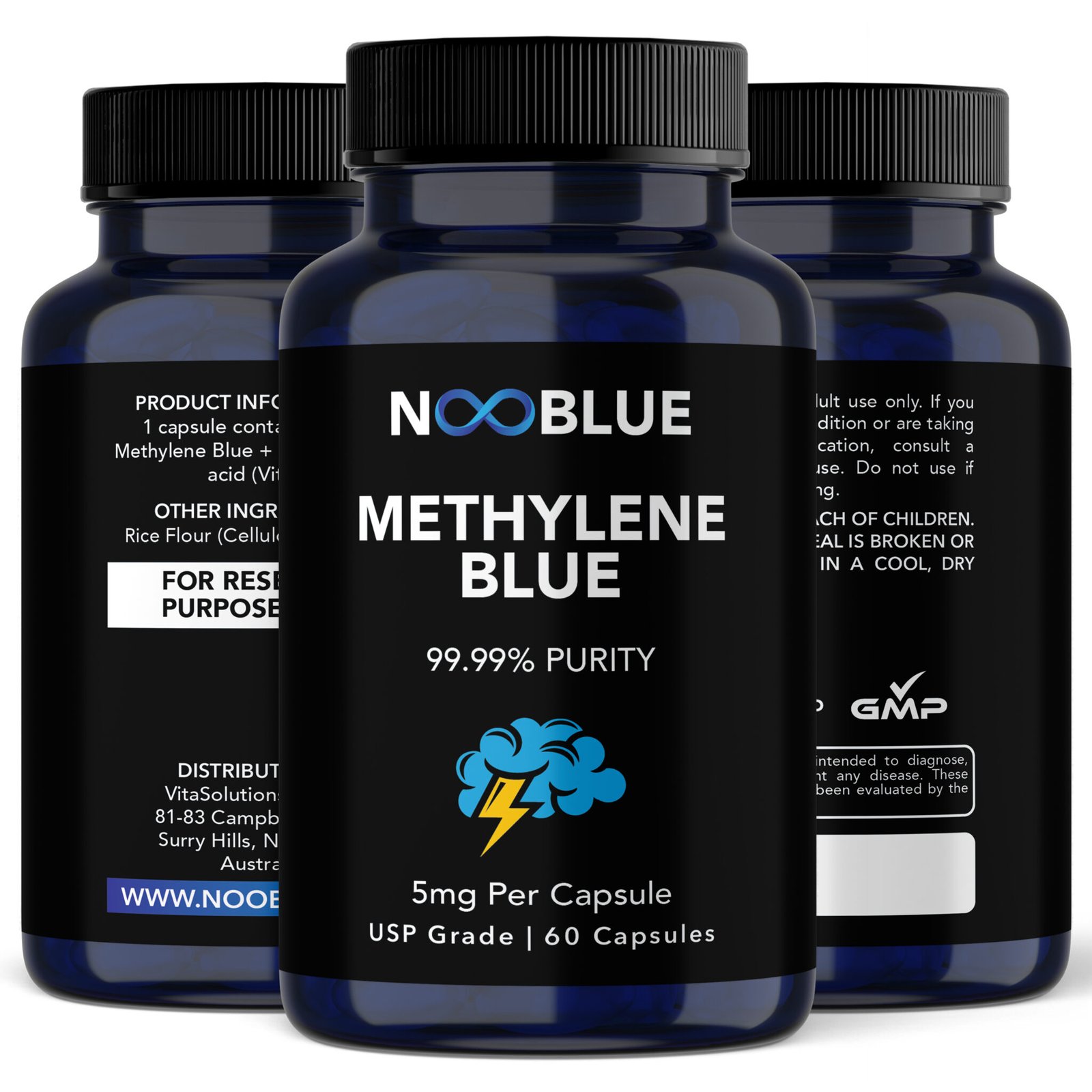
If you’re more concerned about wrinkles and skin health, there’s promising news. In 2017, Zheng-Mei Xiong and colleagues at the University of Maryland reported in Scientific Reports that methylene blue extended the lifespan of human skin fibroblasts in the lab. It improved elasticity and reduced oxidative damage. Imagine a cream that could help your skin stay younger for longer. Researchers are already testing methylene blue in skincare formulas.Looking for clean, USP-grade methylene blue? NooBlue’s Methylene Blue Capsules ship with a verified COA and precise 5mg dosing for $37.99. Shop the full range →
What Benefits Could You Expect?
Here’s what early studies suggest methylene blue might do for you:- Boost your cellular energy so you feel more vibrant.
- Protect your cells from oxidative stress.
- Help preserve memory and cognitive sharpness.
- Offer neuroprotection against age-related brain decline.
- Improve your skin elasticity and reduce visible wrinkles.
Keep the evidence hierarchy in mind as you read those bullets. The mitochondrial and memory findings come mainly from cell and animal work (Atamna & Kumar; Rojas et al.), the skin findings from cultured human skin cells (Xiong et al.), and the human trials that exist are small and short. None of them measured whether a healthy adult taking a low daily dose ages more slowly. What they support is a plausible mechanism, which is why methylene blue is discussed as a longevity candidate rather than sold as a proven one.
Myths You Shouldn’t Believe
Myth 1: Methylene Blue is a proven anti-aging cure. It’s not. The anti-aging data come from cell cultures, animal studies, and a handful of small human trials; no large clinical trial has tested methylene blue against aging itself.Myth 2: You’ll see instant results. True anti-aging changes take time. Don’t expect methylene blue to work like flipping a switch.Myth 3: Any dose is safe. Not true. The positive results in studies come from very low doses. High doses can be dangerous and cause nausea, dizziness, or even serotonin syndrome if you’re taking antidepressants.Safety: What You Need to Know Before Trying It
If you’re considering methylene blue, here’s what matters most:- Stay within safe doses: Benefits only appear at low, carefully controlled doses.
- Watch for drug interactions: If you’re on SSRIs, SNRIs, or MAOIs, methylene blue can interact dangerously.
- Always consult your doctor: Don’t self-experiment. A healthcare professional can guide you on whether it’s safe for you.
The Future of Methylene Blue in Anti-Aging
Scientists are especially excited about mitochondria-focused longevity therapies, and methylene blue is part of that movement. Early evidence from journals like the Journal of Biological Chemistry (Wen et al., 2011) and Scientific Reports (Xiong et al., 2017) shows strong potential, but large clinical trials are still needed.In the future, you may see methylene blue in brain health supplements or anti-aging skin creams, but right now it’s still considered experimental.Key Takeaways
Methylene blue could be one of the most promising anti-aging tools in the near future. If you care about energy, memory, and youthful skin, the science suggests it may help. But you should also know that it’s not a miracle cure, and research is still ongoing.For now, think of methylene blue as an interesting scientific breakthrough to watch closely. If you decide to try it, do so only under medical supervision—your long-term health and safety come first.References- Atamna, H., & Kumar, R. (2010). Protective role of methylene blue in Alzheimer’s disease via mitochondria and cytochrome c oxidase. Journal of Alzheimer’s Disease, 20(2), 607–620. DOI: 10.3233/JAD-2010-1390
- Rojas, J. C., Bruchey, A. K., & Gonzalez-Lima, F. (2012). Neurometabolic processes for memory enhancement and neuroprotection of methylene blue. Progress in Neurobiology, 96(1), 32–45
- Xiong, Z. M., Choi, J. Y., Wang, K., Zhang, H., Tariq, Z., Wu, D., Ko, E., LaDana, C., Sesaki, H., & Cao, K. (2017). Methylene blue alleviates nuclear and mitochondrial abnormalities in progeria.
- Wen, Y., Li, W., Poteet, E. C., Xie, L., Tan, C., Yan, L. J., Ju, X., Liu, R., Qian, H., Marvin, M. A., Goldberg, M. S., She, H., Mao, Z., & Yang, S. H. (2011). Alternative mitochondrial electron transfer as a novel strategy for neuroprotection.
Continue reading
Last updated: September 2, 2026
Skin and energy questions come up especially often from women; our guide to methylene blue benefits for women covers those angles in more detail.
Methylene Blue vs NMN: Which Supplement Is Better for Energy, Brain Health, and Longevity? →Methylfolate vs Methylene Blue – Features, Benefits, & Key Differences →Shop NooBlue
Browse our full range of methylene blue products at the NooBlue shop.
Skin Cream or Oral Supplement? What the Anti-Aging Studies Actually Tested
Most of the search interest around methylene blue and aging is about skin, so it helps to be precise about what the skin research did. Xiong and colleagues applied methylene blue directly to human skin fibroblasts and reconstructed skin tissue in the lab. In that setting it extended the cells’ lifespan, improved elasticity, and reduced oxidative damage, and the published findings also describe better hydration and a thicker dermis. Those are topical, cell-level results. Nobody in that study swallowed a capsule, and no published trial has photographed wrinkles before and after oral methylene blue.
The two product categories therefore answer different questions. A methylene blue cream is an attempt to reproduce the fibroblast results on living skin; it remains experimental, and outcomes depend on formulation and concentration. An oral low-dose supplement, for example one 5 mg capsule in the morning, targets the mitochondrial and cognitive pathways covered earlier, where methylene blue works as an alternative electron carrier. If wrinkles are your main goal, the topical route is the one the evidence speaks to; if energy and memory are, the oral route is. No published human study has shown that oral dosing changes skin appearance.
How Much Methylene Blue Do People Take for Healthy Aging?
The positive study results came from low doses, and daily supplement use follows the same logic. The low-dose range discussed for daily use is roughly 0.5–1 mg per kg of body weight, and most people start well below that with a single 5 mg capsule in the morning, holding there for a couple of weeks before deciding whether to adjust. Take it before about 2 PM: methylene blue has a mild stimulating effect, and later doses can disturb sleep. Higher amounts are where the nausea, dizziness, and serotonin risk described above appear, so more is not better here. Do not use it at all if you take SSRIs, SNRIs, or other serotonergic drugs, if you have G6PD deficiency, or if you are pregnant or breastfeeding. Our methylene blue dosage guide walks through weight-based amounts and the capsule, gummy, and drop formats.
Frequently Asked Questions
How quickly do methylene blue benefits appear?
Some users notice cognitive benefits within days, while cellular-level changes may take several weeks of consistent use. Individual responses vary based on dosage, health status, and overall lifestyle factors.
Is methylene blue a proven supplement?
Methylene blue has over a century of medical research behind it. While human clinical trials are still ongoing for some applications, laboratory and animal studies have shown promising results across multiple health domains.
Who should avoid methylene blue?
People taking SSRIs, SNRIs, or MAO inhibitors should avoid methylene blue due to the risk of serotonin syndrome. Pregnant or breastfeeding women and people with G6PD deficiency should also avoid it.
Does methylene blue actually make you look younger?
Not in the before-and-after sense people search for. The skin evidence comes from the 2017 University of Maryland work, which applied methylene blue directly to human skin fibroblasts and lab-grown skin tissue, where it extended cell lifespan, improved elasticity, and reduced oxidative damage. No published human trial has measured wrinkles or appearance after taking methylene blue by mouth. If skin is your goal, the topical route is the one the data speak to, and even that is still experimental. An oral low-dose supplement is better understood as mitochondrial and cognitive support.
Which methylene blue anti-aging claim has the strongest evidence — energy, brain, or skin?
Ranked by how much human data sits behind them: brain first, energy second, skin last. The cognitive case has small human trials as well as the animal work of Rojas and colleagues. The energy case rests on mitochondrial cell and animal studies such as Atamna and Kumar, with human experience largely self-reported. Skin comes last because it is entirely cell-culture work so far. None of it amounts to a proven anti-aging treatment, and wrinkle-reversal marketing is the weakest claim of the set.
Recommended for you
Related reading: For a broader stack beyond methylene blue, see our roundup of the best anti-aging supplements backed by research in 2026.
Ready to try NooBlue methylene blue?
USP grade · Verified COA · Free worldwide shipping over $100
Shop NooBlue →