Key takeaways
- Powder and liquid are the same molecule. Powder is raw methylene blue you weigh and dissolve yourself. A 1% liquid is already dissolved at 10 mg per mL.
- Powder is the cheapest per milligram. One USP powder costs $29.99 for 5 g (as of Sep 2026), about $0.03 per 5 mg, against $0.30 for a 5 mg serving of NooBlue 1% drops.
- Accuracy is the catch. On a scale that reads to 0.001 g, a 1 mg error is 20% of a 5 mg dose, and many powders are a hydrate that is only about 86% methylene blue by weight.
- For capsules vs liquid, no study has compared the two head to head at supplement servings. Pick on dose size, taste and staining.
- Whatever the form, do not take methylene blue with SSRIs, SNRIs, MAOIs or other serotonergic medicines, or if you have G6PD deficiency, are pregnant or breastfeeding, or are under 18.
Quick answer: methylene blue powder is the cheapest and most flexible form, but you have to weigh it on a milligram scale and dissolve it yourself, and small errors make big dose changes. A pre-made 1% liquid costs more per milligram, yet every drop holds a known amount, so dosing is a matter of counting. For most people taking methylene blue as a supplement, a finished product is the better choice. Our pick is NooBlue’s 1% drops if you want to adjust your dose, or the 5 mg capsules if you want a fixed dose with nothing to measure.
NooBlue makes the drops, capsules and gummies compared here, and we do not sell powder, so read this with our stake in mind. The powder figures come from a USP powder seller’s own product page. Written by the NooBlue editorial team.
Table of contents
- 1. Powder vs Liquid Methylene Blue at a Glance
- 2. What Methylene Blue Powder Actually Is
- 3. What Pre-Made Liquid Methylene Blue Offers
- 4. Dosing Precision: Where the Formats Diverge Most
- 5. Methylene Blue Capsules vs Liquid (Pills vs Drops)
- 6. Methylene Blue Gummies vs Liquid
- 7. Safety, Handling and Storage Differences
- 8. Who Should Not Take Methylene Blue, in Any Form
- 9. Cost Comparison
- 10. Which Form Should You Choose?
- 11. Frequently Asked Questions
- 11.1. Which form of methylene blue is best?
- 11.2. Is it okay to take methylene blue every day?
- 11.3. Why do I feel so good on methylene blue?
- 11.4. What should you not mix with methylene blue?
- 11.5. Can I make my own methylene blue liquid from powder?
- 11.6. Does methylene blue powder absorb better than liquid?
- 11.7. Does powder last longer than liquid?
- 11.8. Is lab-grade powder the same as USP grade?
- 12. Pick the Routine You Will Keep
- 13. Sources
Powder vs Liquid Methylene Blue at a Glance
Prices as of Sep 2026. Cost per 5 mg is worked out from each product’s stated contents.
| Product | What you get | Price | Cost per 5 mg | Measuring | Mouth staining |
|---|---|---|---|---|---|
| NooBlue 1% drops | 50 ml of 1% USP solution, 0.5 mg per drop | $29.99 | $0.30 | Count 10 drops | Can stain |
| NooBlue capsules | 60 capsules, 5 mg each, plus 10 mg vitamin C | $37.99 | $0.63 | None | None, swallowed |
| NooBlue gummies | 60 gummies, 10 mg each, plus 25 mg vitamin C | $49.99 | $0.83 per 10 mg gummy | None | No blue mouth |
| UFC Bio USP powder | 1 g or 5 g of powder in an amber glass vial | $12.50 (1 g), $29.99 (5 g) | About $0.06 (1 g), $0.03 (5 g) | Scale, water, glassware | Stains anything it touches |
Powder wins on price by a wide margin. The rest of this guide is about what you give up for that saving, and when it is worth it.
What Methylene Blue Powder Actually Is
Methylene blue powder is the raw compound as a dark blue-green crystalline powder. USP grade means it meets the United States Pharmacopeia monograph, which requires not less than 97.0% and not more than 103.0% methylene blue, calculated on the dried basis. It is sold by the gram. UFC Bio, one of the USP powder listings in the search results for this topic, sells 1 g for $12.50 and 5 g for $29.99 on its own store, and tells buyers to add 1 g to 100 mL of water to make a 1% solution.
On paper, 1 g of methylene blue makes 100 mL of 1% solution holding 1,000 mg, enough for 200 servings of 5 mg. In practice there is a wrinkle. Methylene blue powder is often a hydrate, and water counts toward its weight. PubChem lists methylene blue at a molecular weight of 319.9 and methylene blue trihydrate at 373.9, so 1 g of the trihydrate holds only about 855 mg of methylene blue, roughly 86% of the label weight. The “dried basis” in the USP definition exists for exactly this reason. If you mix your own solution, check whether the powder’s label and certificate state the water content, because your 1% solution may really be closer to 0.86%.
The other catch is size. A 5 mg serving of powder is a speck. Measuring it directly needs a scale that reads to 0.001 g, and at that resolution a reading error of 1 mg is 20% of the dose. Fine powder also clings to weighing boats and spatulas through static, which pushes the error further. That is why people who use powder rarely weigh single servings. They weigh a larger amount once, dissolve it into a stock solution of known strength, and measure doses from the liquid.
Our guide to the best methylene blue powder compares powder sellers in more detail, and lab grade vs pharmaceutical grade methylene blue explains why the grade on the label matters.
What Pre-Made Liquid Methylene Blue Offers
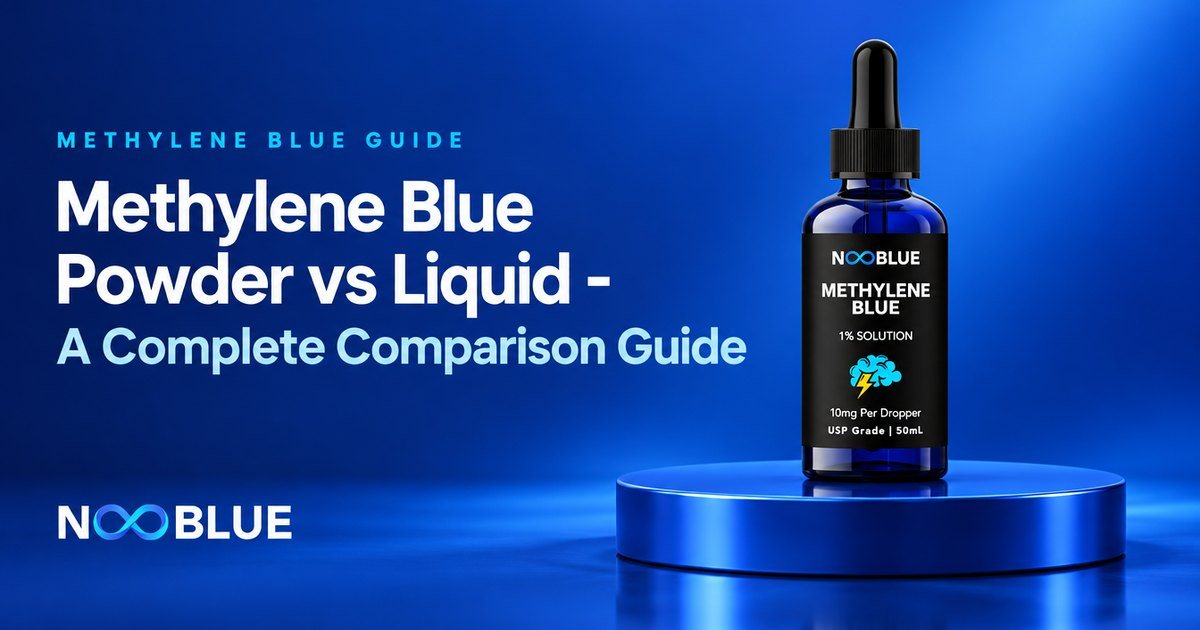
A pre-made liquid is methylene blue already dissolved in water at a stated strength. A 1% solution holds 10 mg per mL, so a 50 mL bottle holds 500 mg. NooBlue’s drops list two ingredients, USP methylene blue and distilled water, and come with a glass dropper. Each drop delivers about 0.5 mg, 10 drops give 5 mg, and a full dropper of about 20 drops gives 10 mg. A bottle provides about 100 servings at 5 mg. The label asks you to keep it tightly closed, away from heat and sunlight.
Strength is the first thing to check on any liquid, because “drops” mean different doses in different bottles. Meraki Blu’s product page lists 150 mg in 30 mL, which is a 0.5% solution at about 0.25 mg per drop. Nootlyn’s Amazon listing sells a 5% solution at about 2.5 mg per drop. The same 10 drops would give about 2.5 mg, 5 mg or 25 mg depending on which bottle you hold. Our methylene blue drops buyer’s guide compares liquid brands, and our methylene blue drops guide covers strength and quality checks.
Taking a liquid is simple. Count the drops or draw a measured amount, then take it directly or mix it into water or juice. There is no weighing and no dissolving. Our guide on how to take methylene blue drops covers technique, including how to keep the blue off your tongue.
Dosing Precision: Where the Formats Diverge Most
Dosing accuracy is the most important practical difference between powder and liquid.
Powder on a milligram scale. Weighing a single 5 mg serving is at the edge of what a home scale can do, as shown above. The stock solution method solves most of this. Dissolving 100 mg in 100 mL of distilled water, for example, gives 1 mg per mL, and a 1 mL oral syringe then measures servings to a fraction of a milligram. The accuracy now depends on that one 100 mg weighing, on the hydrate question, and on your labeling.
Pre-made liquid. At 1% strength, 0.1 mL equals 1 mg, so a 1 mL syringe with 0.1 mL marks measures 1 mg steps. With NooBlue’s dropper, each drop is about 0.5 mg. Drop size can shift with how you hold and squeeze a dropper, so count slowly and hold it upright.
Why does precision matter at all? Methylene blue does not behave like a drug where more is simply stronger. A 2012 review in Progress in Neurobiology describes a hormetic dose response, with opposite effects at low and high doses in the animal research it covers (Rojas et al., 2012). In human cell culture, methylene blue raised mitochondrial complex IV by 30% and oxygen consumption by 37 to 70% at nanomolar levels (Atamna et al., 2008). Those are laboratory and animal findings. They explain why researchers care about dose. They do not show what a given dose does in people.
For a starting amount and timing, see our guide on how many mg of methylene blue per day.
Methylene Blue Capsules vs Liquid (Pills vs Drops)
Many readers who start with powder vs liquid end up choosing between capsules and drops, so here is that comparison. The short version: no study has compared methylene blue capsules with methylene blue drops head to head at supplement servings, so absorption is not a reason to pick one over the other.
What the human studies do show:
- Swallowed liquid is well absorbed. In 16 healthy adults, a 500 mg oral dose of methylene blue in water had an average absolute bioavailability of 72.3% compared with an IV dose (Walter-Sack et al., 2009).
- Not every study agrees on how much reaches the blood. In 7 volunteers given 100 mg, blood levels after the oral dose were much lower than after IV, while urinary excretion was 18% of the dose after oral use and 28% after IV (Peter et al., 2000). The authors put the gap down to differences in where the drug goes in the body.
- Capsules were used in the best-known brain imaging trial. The 2016 University of Texas trial gave 26 healthy adults a single 280 mg dose (about 4 mg/kg) of USP methylene blue, or placebo, in opaque capsules, and measured changes in brain activity one hour later (Rodriguez et al., 2016).
So both routes deliver methylene blue into the body. The real differences are practical.
| NooBlue 5 mg capsules | NooBlue 1% drops | |
|---|---|---|
| Dose step | Fixed 5 mg per capsule | 0.5 mg per drop |
| Other ingredients | 10 mg vitamin C, rice flour, cellulose capsule | Distilled water |
| Taste and staining | No taste, nothing touches the mouth | Can stain the mouth and tongue |
| Price as of Sep 2026 | $37.99 for 60 | $29.99 for 50 ml |
| Cost per 5 mg | $0.63 | $0.30 |
| Best for | A fixed daily routine with no measuring | Adjusting the dose or keeping cost down |
Pills suit people who want the same 5 mg every day and never want to see blue on a spoon. Drops suit people who want to move in small steps or pay less per serving. Our 1% solution vs 5 mg capsules comparison goes deeper, and the newer capsules vs liquid guide and our liquid vs capsule bioavailability article cover absorption in detail. If you are weighing tablets instead, see methylene blue tablets vs liquid.
See the 5 mg capsules · $37.99Methylene Blue Gummies vs Liquid
Gummies are the third finished option. Each NooBlue gummy holds 10 mg of methylene blue and 25 mg of vitamin C in a Wild Blueberry pectin chew with 0 g sugar. NooBlue gummies don’t leave the blue mouth or tongue that drops can, and there is nothing to measure. The trade-offs are a fixed 10 mg step and a higher cost: $0.83 per 10 mg gummy against $0.30 per 5 mg serving of drops. With any format, urine can turn blue or green.
Choose gummies once you know 10 mg a day suits you and you want the easiest routine. Choose drops if you want smaller steps or the lowest cost. Our gummies vs liquid comparison and gummies vs capsules cover the details.
Safety, Handling and Storage Differences
Staining. Methylene blue is an intense dye in any form, and NooBlue’s own drops page warns that the liquid can stain skin, fabric and surfaces. Powder is harder to control: a few spilled grains on a damp counter, sleeve or fingertip leave a deep blue mark. If you work with powder, use gloves, a disposable surface and a spoon or spatula you keep only for this.
Contamination. When you make your own solution, you control the water, the bottle and the cleanliness of every tool. Distilled water and a clean amber glass bottle are the minimum. A finished liquid removes those variables, though it is still worth checking what the maker says about its ingredients and testing.
Storage. Keep any methylene blue sealed, cool and out of direct light. For NooBlue’s drops and capsules, the label says to keep the bottle tightly closed in a cool, dry place away from direct heat and sunlight. A homemade solution should carry a label with its strength, the date you mixed it and the powder batch you used.
Grade. Methylene blue is also sold for aquariums and laboratories. Kordon’s aquarium product, for example, is a 2.303% solution labeled “not intended for human consumption”. Some liquids aimed at people are also described as “for research purposes only” on their own pages. For anything you plan to swallow, look for USP grade and a certificate you can read. Our guides on aquarium grade methylene blue and how to test if methylene blue is real explain the differences.
On testing: the lab report NooBlue publishes covers the raw methylene blue ingredient. Contract Testing Laboratories of America (CTLA) confirmed identity by HPLC and tested heavy metals on one ingredient lot. It does not certify each finished batch or give a purity percentage. You can read it on the drops product page, and our certificate of analysis guide explains what to look for in any brand’s report.
Who Should Not Take Methylene Blue, in Any Form
These rules apply to powder, liquid, capsules and gummies alike:
- Do not take methylene blue if you take an SSRI, SNRI, MAOI or any other serotonergic medicine, including many antidepressants. The combination can cause serotonin syndrome. Our guide to methylene blue and serotonin syndrome explains why.
- Do not take it if you have G6PD deficiency, because it can break down red blood cells.
- Do not take it if you are pregnant or breastfeeding.
- It is not for anyone under 18.
- Talk to your doctor first if you take any prescription medicine, or if you have a kidney or liver condition.
Methylene blue can turn urine blue or green, whatever the form, and that is expected. The same warnings appear in the “Safety: read before use” box on every NooBlue product page. Our guides on who should not take methylene blue, what not to take with methylene blue and methylene blue side effects cover the details.
Cost Comparison
Powder is the cheapest format by a wide margin. At UFC Bio’s store prices, the 5 g vial works out to about $0.03 per 5 mg and the 1 g vial to about $0.06. NooBlue’s 1% drops cost $0.30 per 5 mg serving, the capsules $0.63 per 5 mg capsule, and the gummies $0.83 per 10 mg gummy.
The powder price leaves out the kit: a scale that reads to 0.001 g, oral syringes, distilled water and amber glass bottles. If you already own them, powder stays the budget choice. If you are buying them for a first bottle, the saving shrinks, and you still carry the accuracy risk. On NooBlue’s store, buying 2, 3 or 5 bottles of any format saves 10%, 15% or 20%, and orders of $100 or more ship free worldwide. Browse every format in the NooBlue shop.
Which Form Should You Choose?
Powder suits experienced users who already own a 0.001 g scale and glassware, are comfortable making and labeling a stock solution, and want the lowest cost. It doesn’t suit beginners, anyone who wants a quick daily routine, or anyone who would rather not risk blue stains on the kitchen counter.
Liquid drops suit people who want to adjust their dose in 0.5 mg steps at a low cost per serving. They don’t suit people who dislike the taste or don’t want any chance of blue on the tongue.
Capsules suit people who want a fixed 5 mg with no taste and no measuring. They don’t suit people who want less than 5 mg or struggle to swallow pills.
Gummies suit people settled on 10 mg a day who want no measuring and no blue mouth. They don’t suit anyone who wants a smaller dose or the lowest price.
Frequently Asked Questions
Which form of methylene blue is best?
For most people, a finished product is best, because the dose is already measured. Our pick is NooBlue’s 1% drops if you want to adjust your dose in 0.5 mg steps, or NooBlue’s 5 mg capsules if you want a fixed dose with no taste and no measuring. Powder is cheaper but only makes sense if you own a 0.001 g scale and are comfortable preparing your own solution.
Is it okay to take methylene blue every day?
NooBlue’s labels give one daily serving. There are no long-term trials of daily methylene blue at supplement servings in healthy adults, so long-term safety at these amounts is unknown. Stay at the label serving, follow the safety rules above, and tell your doctor you take it.
Why do I feel so good on methylene blue?
Some people report feeling more alert, but the human evidence is thin. In the 2016 imaging trial, a single 280 mg dose was linked to a 7% increase in correct answers on a memory retrieval task (Rodriguez et al., 2016). That was one dose, with 13 adults on methylene blue and 13 on placebo. Expectation also shapes how people feel after a new supplement. If you take a serotonergic medicine and feel unusually wired, agitated or sweaty, get medical advice straight away.
What should you not mix with methylene blue?
Do not combine it with SSRIs, SNRIs, MAOIs or other serotonergic medicines, including many antidepressants, because of the risk of serotonin syndrome. Talk to your doctor or pharmacist before combining it with any prescription medicine. Our guide to what not to take with methylene blue lists the main classes.
Can I make my own methylene blue liquid from powder?
Yes. Dissolving 1 g of powder in 100 mL of distilled water gives a 1% solution on paper, as UFC Bio’s directions describe. Check whether your powder is a hydrate, since 1 g of methylene blue trihydrate holds only about 855 mg of methylene blue. Weigh on a scale that reads to 0.001 g, use a clean amber glass bottle, and label it with the strength, date and powder batch.
Does methylene blue powder absorb better than liquid?
No. Powder has to be dissolved before you can take it, and once dissolved it is the same molecule in the same water as a pre-made solution. Claims of better absorption for powder have no study behind them. What powder changes is the cost per milligram and who does the measuring.
Does powder last longer than liquid?
We found no published study comparing how long home-stored powder and liquid last. A homemade solution also depends on how clean your water, bottle and tools were. Follow the expiry date and storage line on the label. For NooBlue drops, that means tightly closed, away from heat and sunlight.
Is lab-grade powder the same as USP grade?
No. USP grade must meet the USP monograph, which sets methylene blue content at 97.0% to 103.0% on the dried basis. Laboratory and aquarium products are made for other uses, and some are labeled as not for human consumption. See our grade comparison for the details.
Pick the Routine You Will Keep
The best format is the one you will take the same way every day: drops if you like to adjust, capsules for a fixed 5 mg, gummies for a fixed 10 mg. For more on what methylene blue does, our brain and cellular health guide and our evidence review of methylene blue for anti-aging are honest about how thin the long-term human data still is. For a brand comparison of liquids, see NooBlue vs Meraki.
Sources
- United States Pharmacopeia. Methylene Blue monograph (USP-NF, official 2022). doi.usp.org
- PubChem. Methylene Blue (CID 6099) and Methylene blue trihydrate (CID 104827), computed molecular weights. CID 6099, CID 104827
- Walter-Sack I, Rengelshausen J, Oberwittler H, Burhenne J, Mueller O, Meissner P, Mikus G. High absolute bioavailability of methylene blue given as an aqueous oral formulation. European Journal of Clinical Pharmacology. 2009;65(2):179-189. PubMed 18810398
- Peter C, Hongwan D, Küpfer A, Lauterburg BH. Pharmacokinetics and organ distribution of intravenous and oral methylene blue. European Journal of Clinical Pharmacology. 2000;56(3):247-250. PubMed 10952480
- Rodriguez P, Zhou W, Barrett DW, Altmeyer W, Gutierrez JE, Li J, Lancaster JL, Gonzalez-Lima F, Duong TQ. Multimodal randomized functional MR imaging of the effects of methylene blue in the human brain. Radiology. 2016;281(2):516-526. PMC5084971
- Rojas JC, Bruchey AK, Gonzalez-Lima F. Neurometabolic mechanisms for memory enhancement and neuroprotection of methylene blue. Progress in Neurobiology. 2012;96(1):32-45. PubMed 22067440
- Atamna H, Nguyen A, Schultz C, Boyle K, Newberry J, Kato H, Ames BN. Methylene blue delays cellular senescence and enhances key mitochondrial biochemical pathways. FASEB Journal. 2008;22(3):703-712. PubMed 17928358
- UFC Bio. Methylene Blue Powder, USP/Pharma Grade (store listing, checked September 2026). ufcbio.com
- Meraki Medicinal. Meraki Blu USP Grade Methylene Blue 150mg (product page, checked September 2026). merakimedicinal.com
- Nootlyn 5% methylene blue drops (Amazon listing, checked September 2026). amazon.com
- Kordon. Methylene Blue (aquarium product page, checked September 2026). kordon.com
- NooBlue. Methylene Blue Drops 1% USP Solution and Ultimate Methylene Blue Capsules product pages (checked September 2026). Drops, Capsules