By NooBlue Editorial · About our editorial standards · Published September 4, 2026 · Last updated September 4, 2026
The bottle arrives, you unscrew the cap, and there is a deep-purple gummy sitting in your palm with no dropper, no measuring, and no instructions beyond a single line on the label. That is the moment most people start searching for how to take methylene blue gummies properly — because a gummy removes the arithmetic that drops force on you, and it removes the ability to fine-tune a dose. One chew is one fixed amount of methylene blue, and everything that matters happens around it: how many, when, with what, and what should never share the same day.
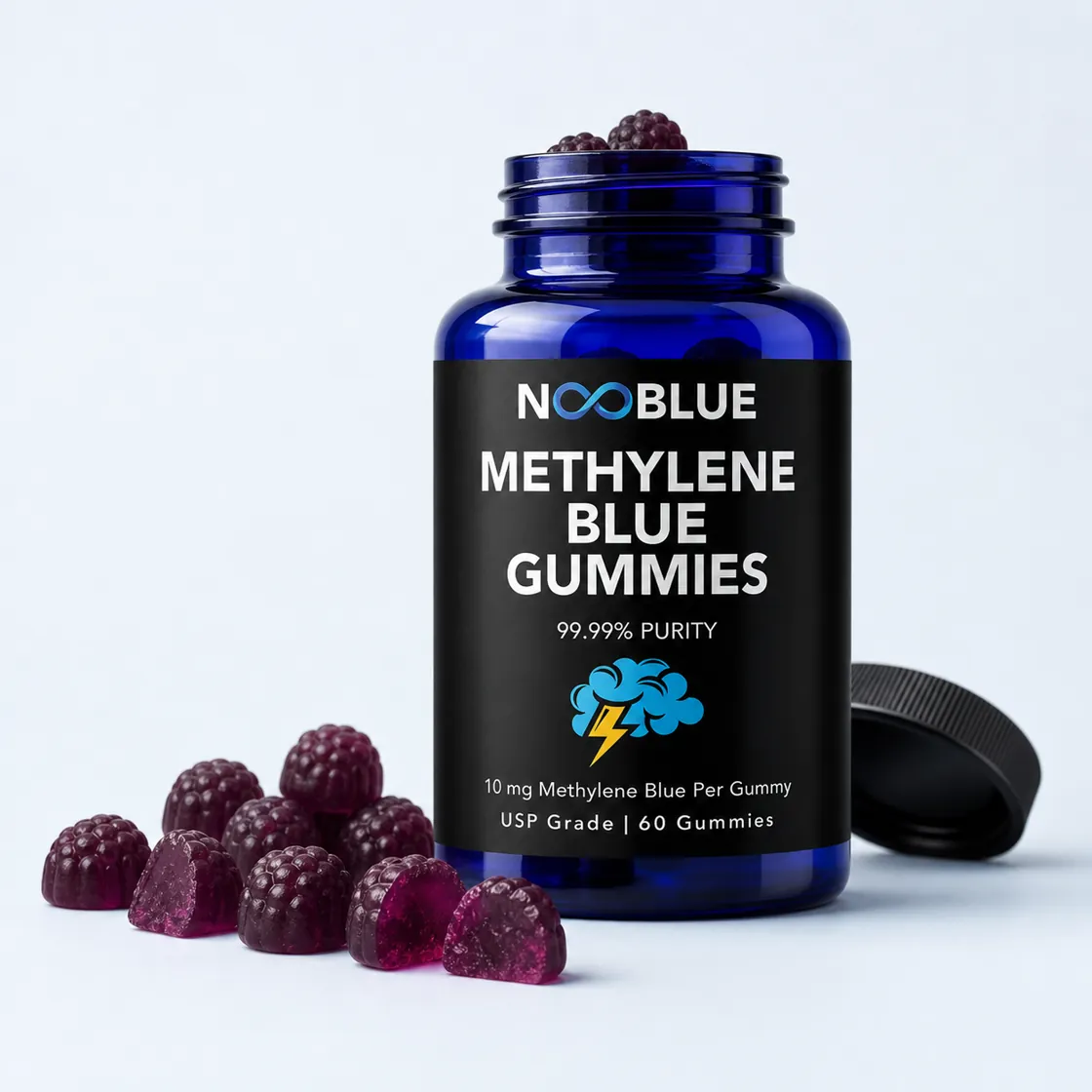
Take one methylene blue gummy per day with food, in the morning or early afternoon, and swallow it whole or chew it fully. A NooBlue gummy delivers a fixed 10 mg of USP-grade methylene blue — no measuring, no titration, no second dose needed.
Key Takeaways
- The whole answer to how to take methylene blue gummies is one gummy daily with food — the dose is fixed at the factory, so there is nothing to measure or convert.
- Earlier in the day beats evening: methylene blue is stimulating for many people, and a late dose can push into sleep.
- The single hard rule is interactions, not amount — methylene blue inhibits monoamine oxidase A, so serotonergic medication is the line you do not cross.
Key numbers:
- 10 mg — methylene blue USP in one NooBlue gummy, paired with 25 mg of vitamin C (serving size: 1 gummy, 60 per bottle).
- 1 mg/kg — the intravenous clinical dose used in hospitals, given over 5 to 30 minutes; roughly 70 mg for an average adult, and nothing like a supplement serving (StatPearls, NCBI Bookshelf).
- 7% — the improvement in correct responses during memory retrieval after a single low oral dose of methylene blue in a randomised, double-blinded, placebo-controlled trial of 26 healthy adults (Radiology, 2016).
- $0.83 — cost per serving of NooBlue Methylene Blue Gummies at $49.99 for 60 servings.
Table of contents
- 1. How to Take Methylene Blue Gummies: The Short Answer
- 2. How Many Methylene Blue Gummies Per Day Is Enough?
- 3. When and How to Take Methylene Blue Gummies for Best Results
- 4. Why Methylene Blue Dosage Advice Contradicts Itself
- 5. What Not to Take With Methylene Blue Gummies
- 6. Frequently Asked Questions
- 6.1. How do you take methylene blue gummies for the first time?
- 6.2. Can I take methylene blue every day?
- 6.3. How many drops of methylene blue is one 10 mg gummy?
- 6.4. Should you take methylene blue gummies with or without food?
- 6.5. What should you not take with methylene blue?
- 6.6. Which form of methylene blue is best?
How to Take Methylene Blue Gummies: The Short Answer
A gummy is a pre-measured unit, which is the entire point of the format. With a 1% solution you are counting drops and converting percentages; with a gummy the manufacturer already did that, and your job is only to be consistent. That shifts the question from “how much” to “which product”, because the dose you get is whatever the brand decided — our comparison of the best methylene blue gummies shows how far apart those decisions are, from 5 mg to 20 mg per chew. Once you have picked one, here is the routine that works for almost everyone:
- Check what one gummy actually contains. Read the supplement facts panel, not the front label. A NooBlue gummy is 10 mg of methylene blue USP per serving. Some competing gummies list a per-bottle figure or a “per two gummies” serving, which is where people accidentally double up — the methylene blue gummies ingredients panel is worth two minutes of your attention.
- Take one gummy with food. Food slows absorption slightly and settles the stomach, which is the most common minor complaint with any oral methylene blue.
- Take it in the morning or early afternoon. Methylene blue is energising for most people. If you are sensitive to stimulants, the best time to take methylene blue is with breakfast, not after dinner.
- Chew it fully or swallow it whole — both work. Chewing gives some oral-mucosa contact; swallowing sends it straight to the gut. The difference in practice is small, and neither is wrong.
- Keep the same time every day for at least two weeks. Methylene blue is not an acute stimulant with a dramatic first-dose effect. Consistency is what makes the difference noticeable.
- Do not stack a second dose to “boost” it. More is not better with this molecule — see the contradiction section below for why that matters more than most articles admit.
How Many Methylene Blue Gummies Per Day Is Enough?
One. That answer sounds glib, so here is the reasoning behind it. Low-dose oral methylene blue in the research literature sits in the single-digit-to-low-double-digit milligram range, and a 10 mg gummy lands squarely inside it. A 5 mg capsule is the beginner rung — useful if you have never taken methylene blue, want to test tolerance, or prefer to titrate upward. A 10 mg gummy is the standard daily serving for someone who already knows they get on with it.
Where people get confused is comparing formats, because every format publishes its dose in a different unit: milligrams per capsule, milligrams per gummy, percent concentration per drop. Normalised to one serving, the NooBlue range looks like this:
| Format | Methylene blue per serving | Price | Cost per serving | Cost per mg | Best for |
|---|---|---|---|---|---|
| Gummies 60×10 mg 1 gummy = 1 serving | 10 mg + 25 mg vitamin C | $49.99 | $0.83 | $0.083 | The easiest daily ritual — no measuring, no blue-mouth mess |
| Capsules 60×5 mg 1 capsule = 1 serving | 5 mg + 10 mg vitamin C | $37.99 | $0.63 | $0.127 | Beginners and anyone titrating from a lower rung |
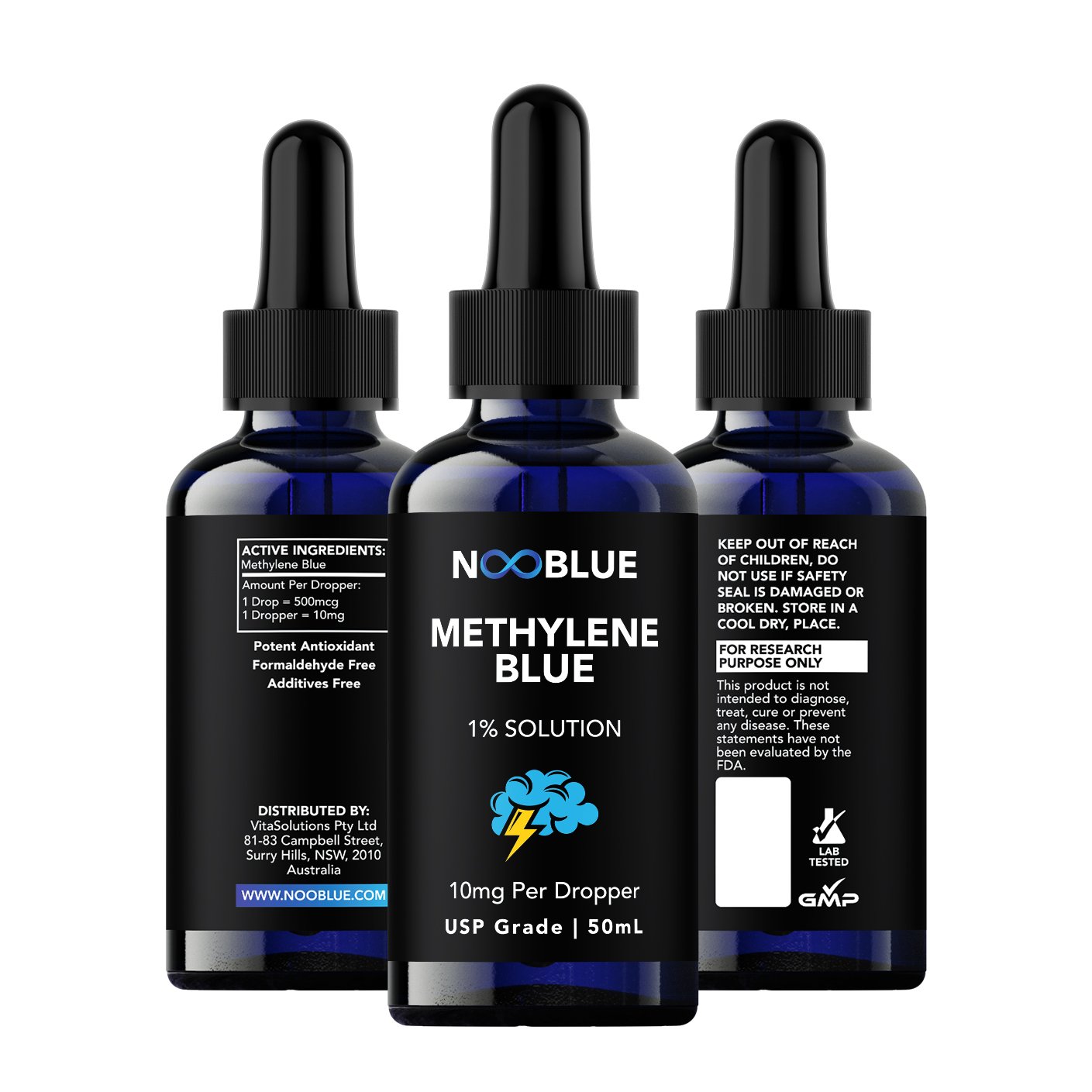
| Solution 1% 50 ml serving = your own drop count | ~0.5 mg per drop (500 mg per bottle) | $29.99 | Varies with drop count | $0.060 | Finest dose control and the lowest cost per milligram |
All three rows are priced per serving in the same unit, which is the only honest way to compare them. The solution is the cheapest per milligram; the gummy is the one you will actually remember to take. If you want the format argument in full, the methylene blue gummies vs capsules breakdown goes deeper than this table can.
Do not cut a gummy in half to halve the dose. This comes up constantly and it does not work the way people assume. A capsule holds a measured powder blend; a gummy is a cast pectin matrix, and the active is dispersed through it rather than sitting in a neat centre. Cutting one gives you an approximation, not a 5 mg serving, and it exposes the cut face to air and moisture. If you genuinely want half the amount, buy the format that was built for it. The upside people miss is the other direction: because the dose is locked, you cannot drift upward either, and dose creep is a far more common failure mode in this category than under-dosing — something the realistic take on methylene blue gummy benefits goes into.
Want to skip the comparison? The NooBlue Methylene Blue Capsules are USP grade with a verified COA and precise 5mg dosing — see the full range →
When and How to Take Methylene Blue Gummies for Best Results
Timing does more work than dose-tweaking. Methylene blue acts as an electron carrier in the mitochondrial electron transport chain, and at low doses it behaves as a respiration enhancer rather than a classic receptor drug — a review in Progress in Neurobiology described exactly that mechanism, along with a hormetic dose–response in which low and high doses produce opposite effects. Practically, that means a steady morning serving beats a large or late one.
Morning or early afternoon. Most people describe a clean, non-jittery lift for several hours. Taken after about 3 pm it can interfere with getting to sleep, which is why methylene blue and sleep quality is the complaint that shows up most often in evening-dosing reports.
With food, not on an empty stomach. NooBlue capsules carry the instruction “take one capsule daily with food” for the same reason a gummy should follow it: mild nausea is the most frequent minor side effect of oral methylene blue, and food largely removes it.
Vitamin C is already in the gummy. This is the part unique to the format. The reduction of methylene blue by ascorbic acid is a well-characterised reaction — kinetics measured directly in the Journal of the American Chemical Society — and NooBlue uses it deliberately, pairing 10 mg of methylene blue USP with 25 mg of vitamin C so most of the active arrives already reduced to leucomethylene blue. That is why the gummy is purple rather than blue, and why there is no blue-mouth mess. The chemistry is explained in full in what leucomethylene blue actually is.
Coffee is fine; stimulant stacking is a judgement call. There is no known interaction between methylene blue and caffeine, but the two together can feel like a lot — methylene blue and caffeine covers where the ceiling usually sits.
Give it two to four weeks. The cell-level effects are slow-building: in human cell culture, methylene blue delayed cellular senescence and enhanced key mitochondrial pathways (The FASEB Journal, 2008) — a laboratory finding, not a promise about how you will feel on day three.
Ready to start? The NooBlue Methylene Blue Gummies are third-party tested by the Clinical Testing Laboratories of America with a published Certificate of Analysis on every batch, at $49.99 for a 60-day supply — precisely dosed at 10 mg, zero sugar, Wild Blueberry. Browse the methylene blue gummy brands compared side by side if you want to see how other 10 mg options measure up, or Shop the 10 mg gummy bottle directly.
Why Methylene Blue Dosage Advice Contradicts Itself
Search for a methylene blue dose and you will be handed four numbers that cannot all be right. This is the single most confusing thing about the topic, and almost nobody explains it, so here are the figures currently sitting on the first page of Google next to each other:
| Figure you will see | Where it comes from | Does it apply to a gummy? |
|---|---|---|
| 1–4 mg per day | Conservative consumer dosage guides describing a narrow “therapeutic window” | Partly. It is a cautious reading of the low-dose range, below what most oral supplements provide. |
| 4–30 mg per day | Compounding-pharmacy write-ups on low-dose oral use | Yes. A 10 mg gummy sits in the middle of this band. |
| 50–300 mg per day | Clinical dosing articles describing medical treatment, not supplementation | No. This is 5 to 30 times a supplement serving. |
| 1 mg per kg of body weight, intravenously | Hospital protocol for methemoglobinemia, given over 5 to 30 minutes (StatPearls) | No. Different route, different purpose, administered by clinicians. |
The numbers contradict because they answer different questions. Two of them describe an emergency medical intervention delivered into a vein to reverse a blood disorder. Two describe daily low-dose oral use for mitochondrial and cognitive support. Blending them is how someone ends up believing 100 mg is a reasonable daily supplement dose, and it is also how the “methylene blue is dangerous” headlines get written — they are usually describing high-dose or intravenous exposure.
A fixed-dose gummy quietly solves this. You are not choosing a number from a contradictory internet; you are taking a unit that was set at 10 mg before it reached you. The trade-off, and it is a real one, is that you cannot go lower than one gummy. That is precisely when a 5 mg capsule is the better starting rung, and why the full NooBlue methylene blue dosage guide treats format and dose as one decision rather than two.
What Not to Take With Methylene Blue Gummies
This is the section that matters. The amount is rarely the problem at supplement doses; the interaction is.
Serotonergic medication is the hard stop. Methylene blue inhibits monoamine oxidase A. That was confirmed experimentally in the British Journal of Pharmacology, where researchers showed MAO-A inhibition accounts for the serotonin toxicity seen when methylene blue is combined with serotonergic drugs. In practice that means SSRIs, SNRIs, MAOIs, triptans, tramadol and similar agents. If you take any of them, do not start methylene blue in any format without speaking to the clinician who prescribed them. The mechanism is unpacked in methylene blue and serotonin syndrome.
G6PD deficiency is a contraindication. Methylene blue can trigger haemolysis in people with glucose-6-phosphate dehydrogenase deficiency, which is why clinical references list it as a reason to use an alternative (StatPearls, NCBI Bookshelf). If you have never been tested and have a family history, get tested first.
Pregnancy and breastfeeding: not the time to experiment. There is no reason to take an optional supplement during either.
The broader list — including combinations that are merely unhelpful rather than unsafe — is in what not to take with methylene blue, and if you are stacking longevity compounds, taking NMN and methylene blue together answers the most common stacking question we get.
One more practical note: purity is a safety variable, not a marketing one. Industrial and aquarium-grade methylene blue is not made to be eaten, and contaminant limits are the reason. Buy a product whose Certificate of Analysis you can actually read — what genuine methylene blue packaging looks like covers the physical tells.
This article is for educational purposes only and is not medical advice. Methylene blue is a potent compound; talk to a qualified healthcare professional before starting any new supplement, especially if you take medication (notably SSRIs or MAOIs) or have a health condition.
Frequently Asked Questions
How do you take methylene blue gummies for the first time?
Take one gummy with breakfast on a day when you have nothing critical scheduled, and note how you feel over the following six hours. If you have never used methylene blue at all, a 5 mg capsule is the gentler starting rung and you can move up to a 10 mg gummy once you know you tolerate it. Do not take two on day one.
Can I take methylene blue every day?
Daily use at low oral doses is how methylene blue is normally taken as a supplement, and the NooBlue gummy bottle is built as a 60-day supply on that basis. What matters more than the calendar is the interaction list — if you take serotonergic medication, no schedule makes it appropriate.
How many drops of methylene blue is one 10 mg gummy?
With a 1% solution, one drop is roughly 0.5 mg, so a 10 mg gummy is broadly equivalent to about 20 drops. Drop volume varies with the dropper and how you hold it, which is exactly the imprecision a fixed-dose gummy removes.
Should you take methylene blue gummies with or without food?
With food. It reduces the mild nausea some people get on an empty stomach, and it does not meaningfully blunt the effect. NooBlue’s own capsule instruction is the same: one serving daily with food.
What should you not take with methylene blue?
Serotonergic medication — SSRIs, SNRIs, MAOIs, triptans and tramadol among them — because methylene blue inhibits monoamine oxidase A. It is also contraindicated in G6PD deficiency. Everything else is a conversation; those two are lines.
Which form of methylene blue is best?
For a daily habit, the gummy: fixed 10 mg, zero sugar, no measuring and no blue mouth. For starting low or titrating, the 5 mg capsule. For the finest control and the lowest cost per milligram, the 1% solution. They are different tools, not better and worse versions of one thing. See our breakdown of how the capsules and the 1% liquid compare if you are choosing between the two.
Start with USP-grade methylene blue
Verified COA on every batch · Free worldwide shipping over $100
Shop NooBlue →